Contact Sales

If you’re interested in hearing more about our products and solutions. Here’s the best way to reach our sales team.

Support

Are you experiencing any issues with our products or solutions? Send us a message through our support portal.

General

Couldn’t find what you are looking for? For general enquiries, send us a message here.

Sample Dataset

Have problems accessing the sample dataset file? For general enquiries, send us a message here.

End Use

Building & Structural

Learn More

End Use

Industrial & Chemical

Learn More

Critical Minerals Category

Base metals

Learn More

Critical Minerals Category

Industrial minerals / non-metals

Learn More

Critical Minerals Category

Iron & ferro-alloys metals

Learn More

Critical Minerals Category

Other metals

Learn More

Critical Minerals Category

Precious metals

Learn More

Critical Minerals Category

Rare earth elements & special metals

Learn More

Tungsten

Tungsten has the highest melting point of any metal at 3,422 °C. It is dense at 19.3 g/cm³, exceptionally hard, corrosion resistant, and chemically stable. The metal is used mainly in alloys and fabricated products for manufacturing, new energy, automotive, electronics, and defence. Substitution is often limited. Tungsten occurs chiefly in scheelite (CaWO₄) and wolframite ((Fe,Mn)WO₄). It is relatively scarce at about 1.5 ppm in Earth’s crust. China is both the largest producer and consumer, supported by large reserves and sustained investment. This concentration shapes the tungsten supply chain. It also frames any credible tungsten market analysis of the global tungsten market.

Strengthen Your Tungsten Supply

Supply Dynamics

  • China accounts for > 80 % mine output and APT; export-licence reviews spur periodic supply squeezes.

  • Vietnam, Rwanda and Russia contribute niche tonnages; sanctions add uncertainty on Russian flows.

  • Sangdong (KR) restart, Mactung (CA) and other project development aiming to meet non-Chinese demand by 2030.

  • EU/US critical-mineral grants underwrite downstream APT and carbide capacity.

  • Secondary recycling (hard-metal scrap) already provides ~30 % of supply and is expanding via tolling contracts.

Demand Dynamics

  • Cemented-carbide inserts follow global machining hours; EV, wind-turbine and aerospace parts sustain high-speed tooling needs.

  • Mining and oil-&-gas drill bits create cyclical bulk demand tied to commodity CAPEX.

  • Defence budgets keep AP penetrator and fragmentation alloy demand resilient.

  • Additive-manufacturing powders for heat-sinks and rocket nozzles grow > 10 % per year.

  • Medical imaging and radiation-therapy collimators add small but high-margin volumes.

Tungsten Market Evolution and Key Applications

Initially a niche material for incandescent filaments, tungsten’s role expanded rapidly after the 1927 development of tungsten-carbide hardmetals, and its strategic value surged in World War II through armour-piercing projectiles and high-speed cutting tools. Over the past several decades, leadership in the global tungsten market shifted from Western nations to China as manufacturing globalised and environmental regulations tightened, making China the dominant force in the industry.

Global tungsten reserves distribution in 2024 [left]. Global tungsten production distribution in 2024 [right].
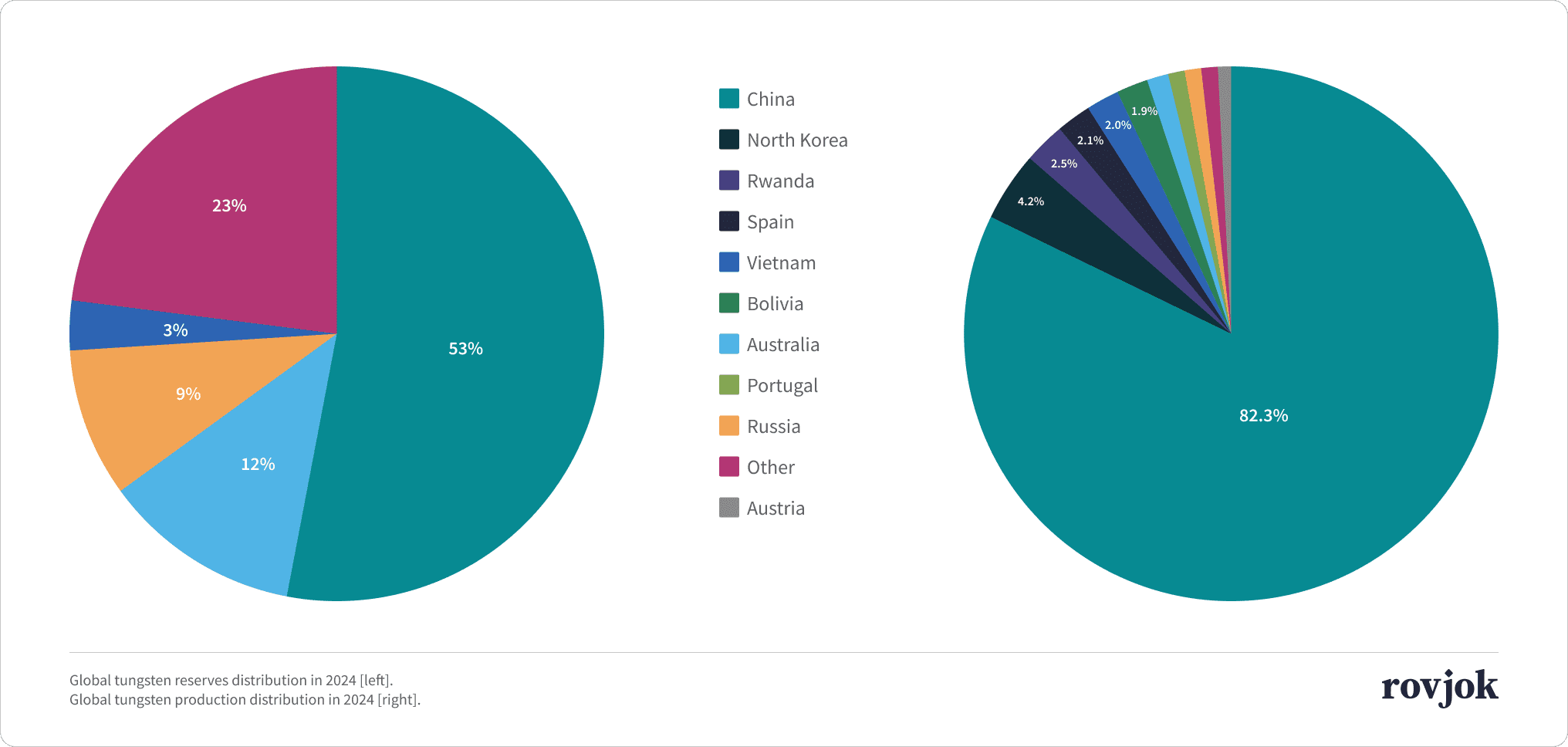
reserves and production tungsten market analysis pie charts

Today tungsten is regarded as a highly strategic critical mineral for defence, with primary value delivered through alloyed and composite forms. Tungsten carbide in cemented carbides is the largest end use, providing cutting, drilling, and wear-resistant tooling across manufacturing and mining. Additional applications include alloy steels for high-temperature machining, superalloys for jet engines and gas turbines, and high-density alloys for penetrators, radiation shielding, and counterweights. Beyond these, uses span energy, aerospace, automotive, medical, and electronics, including silicon-wafer cutting wires, high-voltage electrodes, and filament lamps. Consequently, any credible tungsten market analysis must link end-use growth to the tungsten supply chain and recognise how these applications shape the broader tungsten market.

Tungsten minerals and primary products

Primary extraction centers on wolframite and scheelite. Wolframite typically occurs in quartz veins and pegmatites, while scheelite is often skarn-hosted and strongly fluorescent. Ores are crushed and beneficiated to produce tungsten concentrate at about 50–70% WO₃, marketed near 65% WO₃ with payability referenced to APT at 88.5% WO₃. Hydrometallurgical refining yields ammonium paratungstate (APT), the main traded intermediate, and smelting produces ferrotungsten (75–82% W) for direct steel alloying. These intermediates anchor pricing and flows, so mapping them is central to any tungsten supply chain review and tungsten market analysis.

Request Tungsten Analysis
Golden-orange scheelite crystals on quartz, context image for tungsten market analysis

Supply Chain Overview: China’s Central Role

Global mine production reached about 81,452 metric tons in 2024, up from 79,500 tons in 2023. In any tungsten market analysis, the headline is China’s centrality: it supplies roughly 83 percent of primary output and holds the largest reserves, while mining quotas for early 2025 were cut to 58,000 tons of 65 percent WO₃ concentrate. These policies shape the tungsten supply chain by tightening upstream feed and amplifying price moves at the intermediate stage where China dominates APT and oxide conversion as well as primary refining. Meanwhile, new projects in Kazakhstan, Australia, and South Korea are progressing, although long construction timelines limit near-term additions. The European APT benchmark reaching a 12-year high in mid-2025 underscores structural tightness in the tungsten market, with more than half of China’s refined output absorbed domestically and the balance exported to regions lacking refining capacity.

Tracing the tungsten value chain at an asset-level.

Tracing the tungsten value chain at an asset level for tungsten market analysis, showing flows between key assets.


China’s Upstream Constraints, Rising Consumption, and Project Pipeline

China’s tungsten sector is shaped by provincial geology and policy. Reserves are concentrated in Jiangxi, Hunan, and Henan, and reporting often diverges because domestic statistics use a 65 percent WO₃ basis (51.5 percent W) while USGS reports metal content, which complicates planning across the tungsten supply chain. Ore grades have fallen from about 0.42 percent in 2004 to 0.28 percent in 2020, so authorities manage output via quotas, consolidation, and anti-illegal-mining campaigns, although allocation inefficiencies and over-extraction persist.

On the growth side, very large deposits such as Zhuxi and Dahutang, plus a pipeline that could add about 32 kilotonnes of WO₃ per year by 2027, will expand capacity, yet near-term availability remains governed by quota policy. Meanwhile, consumption of Chinese tungsten is rising and already absorbs more than half of refined output in machining, automotive, electronics, energy, and defence, which tightens the exportable surplus and shapes pricing in the tungsten market. For a rigorous tungsten market analysis, these demand and policy interactions are the critical variables.

China tungsten mine production reached peak in 2021, but production has been curtailed by reduced production quotas [left]. Changes to the Chinese H1 production quotas by province (65% tungsten concentrate) [right].

Tungsten market analysis: China mine output peaked in 2021 then fell; H1 provincial quota shifts for 65% WO3.

Ex-China Supply: Limited Pipeline

Outside China, primary tungsten supply is thin and fragmented. Output totals about 16,500 t WO₃ per year. Volumes come from a few mid-scale mines and many smaller operations. Vietnam’s Nui Phao is the largest Western accessible source. Russian and North Korean output is effectively off-limits for most buyers. Europe, Australia, and Rwanda add modest volumes. These regions face grade, cost, and traceability constraints. The project pipeline remains narrow. Bakuta in Kazakhstan is Chinese owned and likely captive.
Sangdong, Hemerdon, and El Moto could add about 8,700 t WO₃ per year. Delivery depends on financing and execution. In any tungsten market analysis, conditions remain structurally tight. The tungsten supply chain is highly sensitive to Chinese policy and APT pricing.

Aerial view of an open-pit mine representing upstream constraints in the tungsten supply chain for tungsten market analysis.

Other key minerals dependent on China

Secure Your Tungsten Supply

Get tungsten market analysis to map risk, benchmark APT pricing, and plan sourcing with confidence.

Request Analysis